
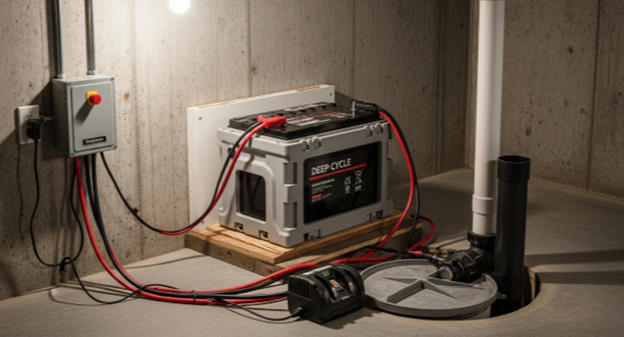
When the power fails during a heavy storm, your sump pump battery becomes your basement’s last line of defense. If that battery dies, water wins. That’s why homeowners constantly ask: how long do sump pump batteries last? At A to Z State Wide Plumbing, we’ve seen firsthand how a properly maintained backup battery can mean the difference between a dry basement and thousands of dollars in water damage.
The real answer depends on battery type, capacity, maintenance, pump size, and how often it runs. Below is the most complete, practical, plumber-level breakdown you’ll find anywhere.
Short Answer — How Long Do Sump Pump Batteries Last?
On average, sump pump batteries last between 3 to 5 years under normal residential conditions. During a power outage, most backup batteries provide 5 to 12 hours of runtime, depending on battery capacity (amp-hours), pump horsepower, and water inflow rate.
In real-world basement installations, properly maintained AGM batteries reliably reach 4–5 years, while neglected systems often fail closer to year three.
What Determines How Long Do Sump Pump Batteries Last?
Battery lifespan is not random. It is influenced by measurable factors.
Battery Type (AGM vs Gel vs Flooded vs Lithium — how long do sump pump batteries last with each?)
Different battery technologies directly impact durability.
- AGM (Absorbent Glass Mat): 3–5 years. Low maintenance. Most common choice.
- Flooded Marine Deep-Cycle: 2–4 years. Budget-friendly but requires upkeep.
- Gel Batteries: 3–6 years. Stable performance.
- Lithium-Ion Systems: 7–10 years. Longest lifespan and runtime.
In heavy storm environments, lithium systems consistently outperform traditional lead-acid models.
Frequency of Power Outages
The more often your battery cycles, the faster it wears.
Homes in:
- Storm-prone regions
- Flood-heavy zones
- Areas with unstable electrical grids
will experience shorter battery lifespans compared to homes with rare outages.
Pump Load & Horsepower
Pump size directly affects battery drain.
- 1/3 HP = more efficient
- 1/2 HP = moderate draw
- 3/4 HP = high demand
Higher vertical lift (distance water travels) also increases energy consumption.
Maintenance Habits
Poor maintenance is a leading cause of premature battery failure.
Common issues include:
- Not testing the system
- Ignoring terminal corrosion
- Allowing flooded batteries to lose water
- Using faulty chargers
Most emergency failures happen because homeowners assume the battery “is probably fine.”
Charging System Quality
A smart charging system extends battery life by preventing:
- Overcharging
- Undercharging
- Voltage fluctuation damage
Low-quality trickle chargers significantly shorten lifespan.
How Long Do Sump Pump Batteries Last During a Power Outage?
Lifespan in years differs from runtime in hours.
Average Runtime by Battery Size
| Battery Capacity | Estimated Runtime (Moderate Use) |
| 40Ah | 4–6 hours |
| 75Ah | 6–8 hours |
| 100Ah | 8–12 hours |
| 120Ah | 10–15+ hours |
Heavy storm cycling can reduce these numbers.
Runtime Based on Pump Activity
- Light rain → longer runtime
- Heavy storm → faster drainage
- Continuous groundwater pressure → rapid depletion
Real-World Example
In one installation, a 75Ah battery supporting a 1/2 HP pump lasted only 6 hours during severe rainfall. After upgrading to a 100Ah AGM with smart charging, the system survived a 10-hour outage without issue.
Capacity selection matters.
How to Extend the Life of Your Sump Pump Battery
Follow this professional-level maintenance process.
Choose the Right Deep-Cycle Battery
Never use car batteries. Choose deep-cycle models designed for sustained discharge.
Install a Smart Charger
Ensure float charging and automatic diagnostics.
Test the Backup System Every 3 Months
Simulate water flow to verify activation and pumping strength.
Clean and Inspect Terminals
Use gloves and a wire brush to remove corrosion buildup.
Replace Before Complete Failure
Proactive replacement around year four prevents risk.
Consider Dual Battery Setup for High-Risk Homes
Dual systems double available runtime and add redundancy.
How Long Do Sump Pump Batteries Last by Type?
| Battery Type | Average Lifespan | Average Runtime | Maintenance Level | Cost Range* | Best For |
| AGM | 3–5 years | 5–8 hrs | Low | $$ | Most homes |
| Flooded Marine | 2–4 years | 4–7 hrs | Medium | $ | Budget setups |
| Gel | 3–6 years | 6–10 hrs | Low | $$$ | Moderate flooding |
| Lithium | 7–10 years | 10–20+ hrs | Very Low | $$$$ | High-risk zones |
Prices mentioned are not official prices. They are example estimates only and may vary by brand, region, and installer.
Lithium delivers the longest lifespan, while AGM offers balanced value for typical residential needs.
Signs Your Sump Pump Battery Is About to Fail
Alarm Beeping Frequently
Indicates charging irregularities.
Battery Won’t Hold Charge
Rapid voltage drop after charging signals decline.
Corrosion Around Terminals
Reduces efficiency and signals aging components.
Slow Pump Response
Delayed activation under load is a warning sign.
Battery Older Than 4 Years
Even functioning batteries lose reliability with age. Most emergency service calls involve batteries that were never tested.
How Often Should You Replace a Sump Pump Battery?
Most professionals recommend replacement every 3–5 years. Waiting for failure increases flooding risk. Replace before storm season for optimal protection. Preventive replacement is significantly cheaper than structural repairs.
Can You Increase How Long Do Sump Pump Batteries Last?
Yes, through strategic upgrades.
Upgrading to Higher Amp-Hour Rating
Higher capacity increases runtime.
Installing Dual Backup Batteries
Adds redundancy and extended protection.
Adding Water-Powered Backup Pump
Operates without electricity.
Switching to Lithium Backup Systems
Longer lifespan and superior performance.
Common Mistakes That Reduce Battery Life
- Installing automotive batteries
- Skipping regular testing
- Allowing full discharge cycles repeatedly
- Ignoring charger malfunctions
- Choosing undersized capacity
Avoiding these errors directly impacts how long sump pump batteries last.
People Also Ask About How Long Do Sump Pump Batteries Last
Do sump pump batteries last through the night?
Large-capacity batteries (100Ah+) often can, depending on cycling frequency.
How long do sump pump batteries last on average?
Typically 3–5 years, with lithium models lasting longer.
Can a sump pump battery run continuously?
No. Continuous pumping drains batteries quickly.
What happens if the battery dies?
Backup protection stops, increasing flood risk.
Is lithium worth the upgrade?
Yes for high-risk homes needing longer runtime.
How do I know if replacement is needed?
Frequent alarms, voltage drops, slow pump response, or age beyond four years.
Can two batteries be connected?
Many systems allow parallel setups for extended runtime.
Does cold weather affect performance?
Yes. Low temperatures reduce capacity temporarily.
Cost Breakdown — Battery Replacement vs Flood Damage
Example estimated costs:
- AGM battery: $150–$300
- Lithium system: $600–$1,500
- Installation: $150–$400
- Dual setup: $400–$1,000
These are not official prices. They are example estimates only. Actual pricing varies by brand, location, and installer.
Average basement flood repair can exceed $5,000–$15,000+.
Preventive battery replacement is significantly more economical.
Final Verdict — How Long Do Sump Pump Batteries Last and What Should You Do?
Most sump pump batteries last 3–5 years, with runtime during outages ranging from 5 to 12 hours, depending on system configuration.
If your home is in a flood-prone area:
- Upgrade battery capacity
- Test quarterly
- Replace proactively at year four
- Consider dual or lithium systems
Your sump pump battery is inexpensive insurance compared to structural flood damage.
When the power goes out, preparation determines whether your basement stays dry or becomes a costly repair project.