

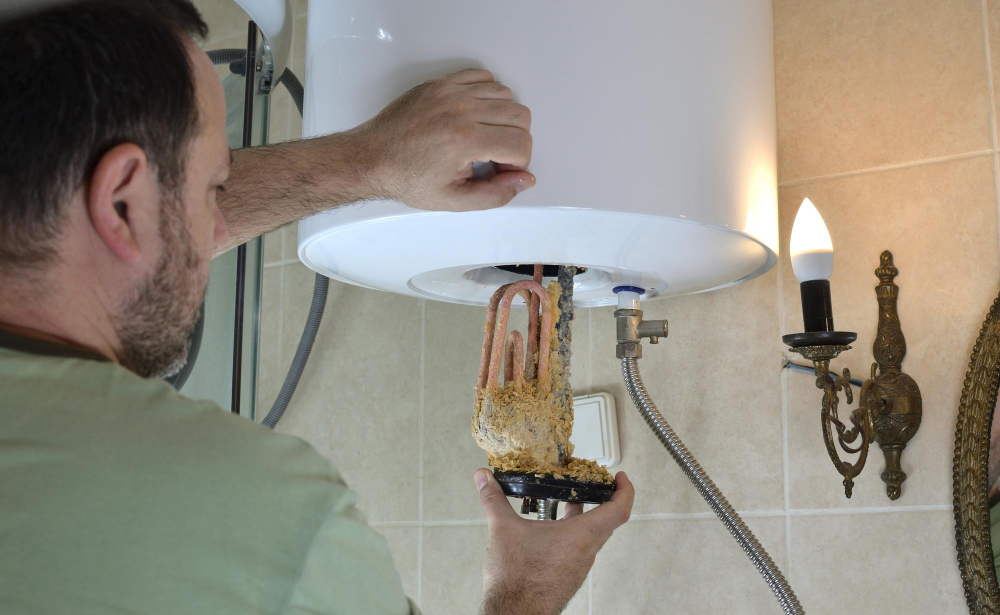
Most homeowners don’t think about what’s happening inside their water heater until something goes wrong. The unit sits in a utility closet or garage, heats water on demand, and gets ignored until it stops working or starts leaking. But inside that tank, a process is happening every day that quietly increases energy costs, shortens the unit’s service life, and reduces the amount of hot water available when it’s needed.
That process is sediment accumulation, and in South Florida, the local water supply makes it happen faster than homeowners might expect.
Where the Sediment Comes From
The water supplied by South Florida utilities carries dissolved minerals, primarily calcium and magnesium carbonate. These minerals are what make the region’s water “hard” by the standard hardness scale. The water is safe to drink and use, but those dissolved minerals don’t stay in solution indefinitely.
When hard water is heated, the minerals precipitate out of solution and settle at the bottom of the tank as a solid layer. Every time the water heater runs a heating cycle, more minerals drop out of the water and add to the layer at the bottom. Over months and years, that layer grows thicker.
The Rate of Buildup in South Florida
South Florida’s water hardness levels vary by municipality, but readings in the moderate to hard range are common across Miami-Dade and Broward counties. In these conditions, a water heater that’s never been flushed can accumulate several inches of sediment within three to five years. Units that have been in place for 10 years or more without maintenance often have sediment layers that take up a significant portion of the tank’s volume.
How Sediment Costs Money
The financial impact of sediment accumulation shows up in two ways: higher energy consumption and premature equipment failure.
The Insulation Effect on Heating Elements
In an electric water heater, the heating elements are positioned to heat the water directly. When a layer of sediment covers the bottom element, that sediment acts as insulation between the element and the water. The element has to run hotter and longer to transfer the same amount of heat through the sediment layer that it would have transferred directly to the water.
The U.S. Department of Energy has documented that significant sediment buildup can reduce a water heater’s efficiency by up to 25 percent. For a household spending $800 per year on water heating, that’s $200 in wasted energy annually. Over five years without maintenance, the cumulative cost is $1,000 or more beyond what the unit should be using.
The Effect on Gas Water Heaters
In a gas water heater, the burner heats the bottom of the tank rather than an internal element. Sediment that sits between the burner and the water produces a similar insulation effect, requiring the burner to run longer to achieve the set temperature. It also creates a condition called rumbling or popping, which is the sound of water trapped beneath the sediment layer being superheated and bursting through. That sound is one of the more reliable indicators that a gas water heater has significant sediment buildup.
What Sediment Does to the Tank
Beyond energy costs, sediment creates physical damage to the tank over time.
Overheating at the Bottom of the Tank
When the heating element or burner has to work harder because of sediment insulation, the bottom of the tank and the element itself run at higher temperatures than they’re designed for. That sustained overheating degrades the anode rod faster, weakens the tank’s glass lining at the bottom, and increases wear on the heating element. Units with heavy sediment accumulation tend to fail earlier than their rated service life.
Anode Rod Depletion
Every water heater tank has a sacrificial anode rod, typically made of magnesium or aluminum, that corrodes in place of the steel tank. As long as the anode rod is intact, it protects the tank from corrosion. Sediment buildup creates conditions that deplete the anode rod faster, and when the rod is gone, the tank itself begins to corrode from the inside. Once that process starts, tank failure and leaking follow.
How to Address Sediment Buildup
Flushing the water heater on an annual basis is the standard maintenance recommendation. The process involves connecting a hose to the drain valve at the bottom of the tank, shutting off the cold water supply and the power or gas to the unit, and draining the tank to remove the accumulated sediment.
What Annual Flushing Does & Doesn’t Fix
Annual flushing removes loose sediment before it has a chance to compact and harden at the bottom of the tank. In a water heater that’s been flushed regularly since installation, this keeps sediment accumulation from becoming a significant problem.
In a water heater that hasn’t been flushed in many years, the sediment at the bottom may have hardened to the point where draining the tank doesn’t fully remove it. In these cases, a professional flush using higher water pressure can break up the compacted material, but if the buildup is severe enough, it may indicate that the unit is past the point where flushing provides meaningful benefit.
When Replacement Makes More Sense
A water heater that’s more than 10 years old, has significant sediment buildup, is showing signs of tank corrosion, and is running inefficiently is usually a better candidate for replacement than aggressive maintenance. The energy savings from switching to a new, efficient unit, especially a heat pump water heater, often pay for the replacement faster than continuing to run an aging, sediment-laden tank.
Getting a plumber to inspect the unit and assess its current condition gives a homeowner a clear basis for deciding between maintenance and replacement.