
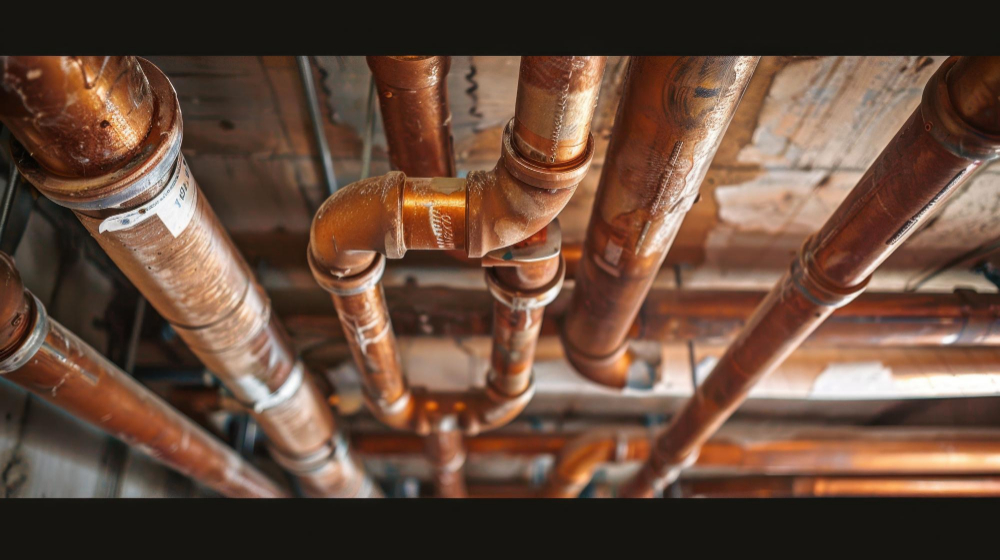
Copper pipe has a long history as a reliable material for residential water supply lines. It handles pressure, resists biological growth, and holds up in a wide range of conditions. In most parts of the country, copper supply lines in a well-maintained home can last 50 years or more without significant problems.
South Florida is not like most parts of the country.
The combination of water chemistry, humidity, salt air, and soil conditions in this region creates an environment where copper pipe develops a specific and frustrating failure pattern: pinhole leaks. These are tiny perforations that form in the pipe wall as a result of corrosion, and the name describes them accurately. The hole that lets water through can be smaller than a pencil tip. But water under pressure through a pinhole in a supply line inside a wall can cause serious damage over time, and the leak is often running for weeks or months before anyone notices.
How Pinhole Leaks Form in Copper
The chemistry behind copper pinhole corrosion involves several variables, and different homes experience it for different reasons. In South Florida, the most common contributing factors are the chloramine content in municipal water, the local water’s pH level, and the presence of salt in the environment.
Chloramine Erosion
South Florida water utilities use chloramines rather than free chlorine to disinfect the water supply in many service areas. Chloramines are more stable than free chlorine and maintain disinfection through longer distribution pipe runs, which makes them useful for a spread-out metropolitan area. But chloramines are more aggressive toward copper than free chlorine, and over time they contribute to the erosion of the inner wall of the copper pipe.
That erosion process is called pitting corrosion. It doesn’t attack the pipe uniformly. Instead, it concentrates at weak points in the copper surface, eating deeper and deeper at those specific locations while the surrounding pipe wall remains relatively intact. Eventually, the pit penetrates the full thickness of the pipe wall and a pinhole leak begins.
Water pH & Copper
Water with a pH below 7 is acidic and more corrosive to copper. The relationship between water pH and copper corrosion is well-documented, and some South Florida municipal water supplies have historically run on the lower end of the neutral pH range. Homes where the water has a slightly acidic pH over many years experience higher rates of pitting corrosion in copper supply lines.
Salt Air & Exterior Copper
For homes near the coast, copper supply lines that are exposed in exterior locations, near hose bibs, at the water meter, or in unconditioned exterior utility areas, face additional corrosive pressure from salt-laden air. The chloride ions in salt air accelerate corrosion on the exterior surface of copper, which can contribute to failure at those points even if the interior corrosion process is slower.
Why Pinhole Leaks Are So Hard to Catch
A pinhole leak in a supply line inside a wall doesn’t give immediate visible signs. The water escaping through the hole is under pressure, but the volume at first is small. It soaks into the wood framing, the insulation, and the drywall before any moisture becomes visible at the surface.
By the time a homeowner sees a water stain on the ceiling, notices a soft spot in the drywall, or detects a mold smell in a closet or cabinet, the leak has typically been running for some time. The water damage behind the wall is often more significant than the surface signs suggest.
Signs That Point to Pinhole Leaks
An unexplained increase in the water bill is one of the more reliable early indicators. A pinhole leak releasing even a small but steady volume of water adds up on a monthly meter reading. If usage hasn’t changed but the bill is climbing, water is going somewhere it shouldn’t be.
Low pressure at a specific fixture, particularly one that was previously fine, can indicate that a leak on that supply branch is diverting water before it reaches the fixture. A faint dripping or running sound inside a wall when no fixtures are in use is another sign worth investigating.
Visible staining on ceilings or walls, bubbling paint, or drywall that feels soft when pressed are later-stage signs that the leak has been present long enough to saturate the surrounding materials.
What Homes Are Most at Risk
Copper supply lines installed in South Florida homes from the 1960s through the 1990s are in the age range where pinhole corrosion becomes statistically likely. Homes that have been on the same water supply zone for decades and haven’t had supply lines replaced or inspected are running on copper that has absorbed decades of chloramine exposure.
Homes in coastal communities, from Miami Beach through Hollywood and into Broward’s eastern cities, face the additional factor of salt air on any exterior copper. And homes where the water heater hasn’t been flushed or maintained regularly often have slightly degraded water quality moving through the supply lines, which contributes to interior corrosion as well.
Repair Options When Pinhole Leaks Are Found
A single pinhole leak can be repaired in isolation, but finding one pinhole in a copper system of a certain age usually means others are developing or will develop soon. A licensed plumber who identifies a pinhole leak in a home’s copper supply lines should be doing a broader assessment of the system’s overall condition.
For homes where pinhole leaks have appeared in multiple locations or where the copper shows widespread pitting when inspected, a full repipe using PEX tubing is often the more sensible long-term approach. PEX doesn’t corrode, isn’t affected by chloramines, and handles South Florida’s water chemistry without the degradation that copper experiences in this environment. The upfront cost of a repipe is higher than patching a single leak, but it replaces the exposure across the whole system rather than waiting for the next pinhole to appear.